




Electric Plastic Ball Valves
DELCO Electric Plastic Ball Valves (UPVC/CPVC) are the ideal choice for corrosive environments. Lightweight yet durable, these motorized valves resist chemical attacks from acids, alkalis, and seawater, offering a long service life in wastewater applications.


-
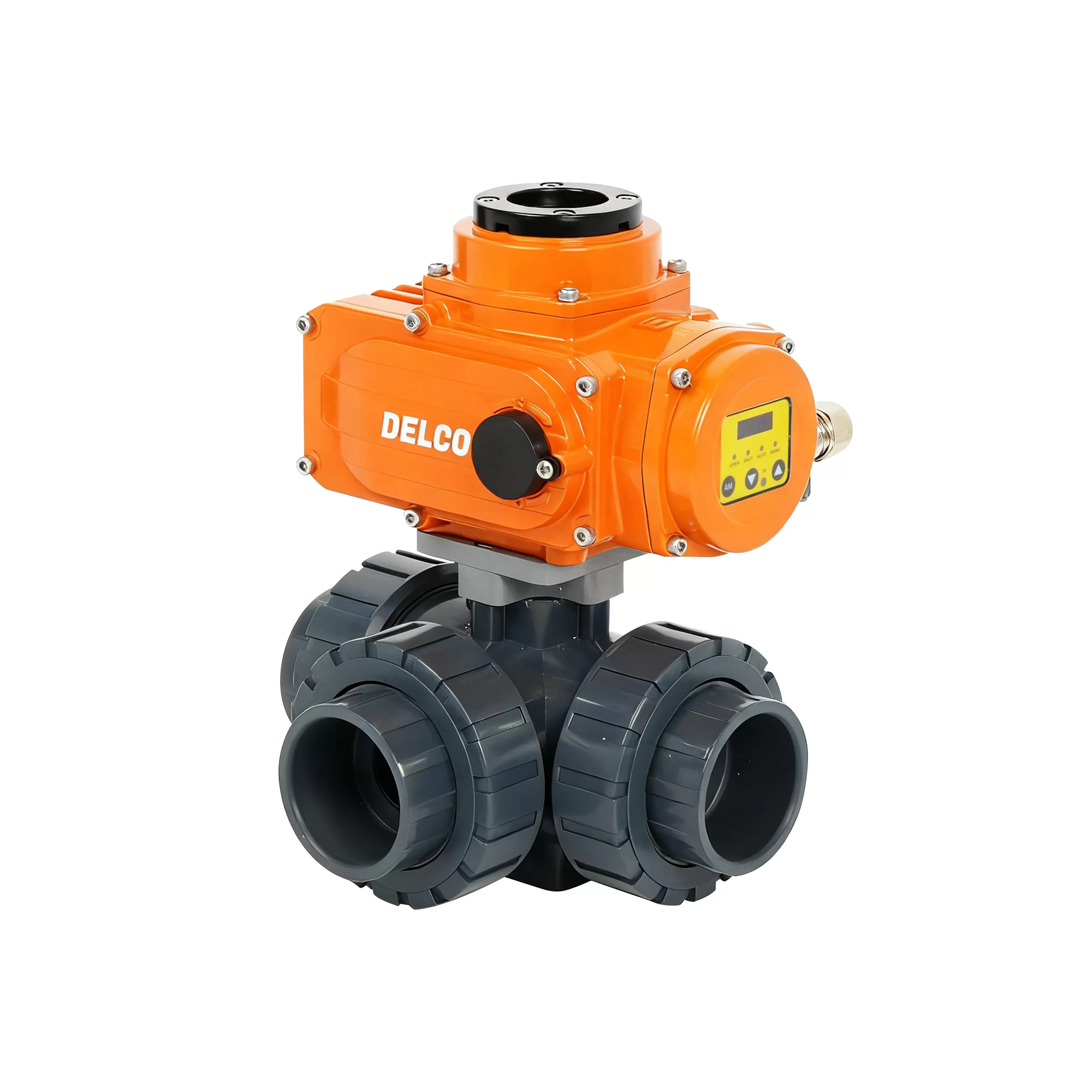
DELCO IP67-DKS55-3PL Electric UPVC 3-Way Ball Valve - Double Union, L/T Port
 Size Range: DN15-DN50
Material: UPVC, CPVC,PPH,PVDF
Connection Type:BW, SW, Thread
-

DELCO IP67-DK55-PVF Electric Plastic Flange Ball Valve - UPVC/CPVC/PVDF
Size Range: DN15-DN100
Material: UPVC, CPVC,PPH,PVDF
Connection Standard: GB / ANSI / JIS /DIN
-

DELCO IP67-DK55-PL Electric UPVC Ball Valve - Double Union, True Union
Size Range: DN15-DN100
Material: UPVC, CPVC,PPH,PVDF
Connection Type:BW / SW / Thread
-

DK55-PL Electric UPVC Double Union Ball Valve - Automated Corrosion Resistant Control
Size Range: DN15-DN100
Material: UPVC, CPVC,PPH,PVDF
Connection Type:BW, SW, Thread
-

DK55-3PL Electric 3-Way UPVC Double Union Ball Valve - Corrosion Resistant Flow Diverter
Size Range: DN15-DN50
Material: UPVC, CPVC,PPH,PVDF
Connection Type:BW, SW, Thread
Electric Plastic Ball Valves (UPVC, CPVC, PVDF & PPH True Union)
DELCO electric plastic ball valves are corrosion-resistant, lightweight automated flow control solutions engineered for chemical processing, water treatment, semiconductor manufacturing, and coastal marine piping. Featuring a 100% non-metallic wetted flow path, these valves eliminate electrolytic galvanic reactions, pitting, and scaling common in metallic valves. As an economical yet durable line within the DELCO electric ball valves series, our thermoplastic assemblies incorporate reinforced ISO 5211 mounting platforms and compact motorized actuators, providing dependable On/Off isolation and precise chemical throttling across UPVC, CPVC, PPH, and high-purity PVDF lines.
True Union Double-Nut Series
Engineered for high-maintenance chemical dosing and skid automation (DN15 to DN100 / 1/2" to 4"). Dual union lock-nuts allow the central valve body to be removed from the pipeline for seat servicing or cleaning without cutting or disassembling adjacent pipe runs.
- End connections: Socket cement, female NPT/BSPT threads, or butt-weld
- Integral body footpad for secure field pipe anchoring
- Bidirectional sealing with self-adjusting PTFE ball seat carriers
Industrial Flanged Plastic Series
Designed for heavy-bore industrial chemical effluent and distribution mains (DN50 to DN200 / 2" to 8"). Manufactured with solid one-piece molded flanges or heavy-duty stub ends compliant with ASME B16.5 Class 150 and DIN PN10 drilling standards.
- Robust flanged body profile resists line thermal stress and vibration
- Full-bore design delivers maximum flow rate with minimal pressure drop
- Available in pure PPH, PVDF, and heavy-wall CPVC constructions
Why Engineers Specify DELCO Plastic Ball Valves
Engineered with reinforced mounting geometry, zero-metal wetted purity, and precision motorized actuators for aggressive chemical handling.
100% Metal-Free Wetted Purity
Every internal component in contact with fluid is molded from pure virgin polymers (UPVC, CPVC, PVDF, PPH) and resilient PTFE/FKM. Eliminates metal ion leaching in ultra-pure deionized water and prevents acid chemical attack.
Reinforced ISO 5211 Top Flange
Standard plastic valves can suffer neck cracking under dynamic motor cycling. DELCO incorporates a heavy-duty reinforced ISO 5211 mounting bracket with brass/stainless threaded inserts to dissipate actuator torque loads safely.
True Union In-Line Maintenance
The double-union nut system allows plant operators to quickly unthread and slip the valve body out of the piping line. Simplifies periodic seat replacement, O-ring inspection, and line flushing without disrupting fixed pipe supports.
PTFE Seats with Cushion O-Rings
Machined virgin PTFE seats are backed by dual elastic EPDM or FKM (Viton) O-rings. This spring-cushion effect maintains continuous sealing contact against the polished thermoplastic ball, ensuring bidirectional ANSI Class VI bubble-tight shut-off.
Ultra-Pure Cleanroom PVDF Option
For semiconductor UPW loops, solar photovoltaic manufacturing, and pharmaceutical dosing, unpigmented virgin PVDF resins provide ultra-low Total Organic Carbon (TOC) and withstand continuous hot acids up to 140°C.
Fast & Energy-Efficient Actuation
Due to smooth thermoplastic ball surfaces, operating torques are remarkably low. Paired with compact IP67 electric actuators offering fast 7–12 second cycling, manual override, visual position beacon, and optional 4–20mA modulation.
Plastic Valve Engineering Matrix & Material Guide
Compare thermoplastic resin properties, working temperature limits, pressure classes, and typical chemical service pairings.
| Material & Capacity Class | Size Range | Working Temperature | Pressure Rating | End Connection Options | Typical Chemical Media |
|---|---|---|---|---|---|
| UPVC Industrial Class | DN15 – DN100 (1/2" – 4") | 0°C to +60°C (32°F to 140°F) | 1.0 – 1.6 MPa (150 psi) | Socket Cement / NPT Threaded | Water Treatment, Brine, Dilute Acids |
| CPVC High-Temp Class | DN15 – DN100 (1/2" – 4") | 0°C to +95°C (32°F to 203°F) | 1.0 – 1.6 MPa (150 psi) | Socket Cement / Threaded | Hot Corrosive Acids, Electroplating |
| PVDF Ultra-Pure Class | DN15 – DN100 (1/2" – 4") | -20°C to +140°C (-4°F to 284°F) | 1.0 – 1.6 MPa (150 – 230 psi) | Butt Weld / Socket Fusion / Flanged | Semiconductor UPW, Wet Chlorine, Nitric Acid |
| PPH Chemical Class | DN15 – DN100 (1/2" – 4") | -10°C to +100°C (14°F to 212°F) | 1.0 MPa (150 psi) | Socket Fusion / Butt Weld | Pickling Acids, Alkalis, Wastewater |
| Flanged Plastic Class | DN50 – DN200 (2" – 8") | Per resin limits | 0.6 – 1.0 MPa (PN10) | ASME B16.5 150# / DIN PN10 | Large Chemical Distribution Mains |
Technical FAQs: Plastic Ball Valve Automation
Essential engineering guidance regarding polymer selection, actuator mounting safety, and seal compatibility.
1. How do I select the right plastic body material (UPVC vs. CPVC vs. PVDF vs. PPH)?
Selection depends primarily on operating temperature and chemical aggressiveness:
• UPVC: Most economical; ideal for general water treatment, dilute acids, and salts up to 60°C.
• CPVC: Retains higher mechanical strength up to 95°C; perfect for hot acid distribution and electroplating lines.
• PPH: Excellent resistance to non-oxidizing acids, solvents, and alkalis up to 100°C; welded piping systems.
• PVDF: High-end fluoropolymer rated to 140°C; essential for ultra-pure semiconductor water (zero leaching) and extreme oxidizers like wet chlorine and nitric acid.
2. How does DELCO prevent the plastic mounting top pad from cracking under motor torque?
Because thermoplastics have lower tensile shear strength than metals, high-torque electric actuators can induce fatigue cracking at the valve neck. DELCO addresses this by incorporating an engineered direct-mount ISO 5211 platform with metal threaded inserts molded directly into the neck ribbing. This distributes torsional and bending stresses uniformly, preventing plastic stress fractures during rapid motor start-stop cycles.
3. What is the difference between EPDM and FKM (Viton) O-ring elastomeric seals?
While the ball seat is always virgin PTFE, the internal backing O-rings must be chemically compatible with your fluid:
• EPDM Seals: Best for municipal water, caustic soda (sodium hydroxide), alcohols, and mild bleaching agents. Not compatible with oils or hydrocarbons.
• FKM (Viton) Seals: Superior resistance to concentrated inorganic acids, chlorine gas, hydrocarbons, and organic solvents. Essential for aggressive chemical dosing skids.
4. Can motorized plastic ball valves perform accurate 4–20mA proportional throttling?
Yes. Because plastic ball valves exhibit very low seat friction compared to metal valves, they operate with minimal hysteresis and zero stick-slip. When coupled with DELCO high-resolution modulating electric actuators (incorporating 4–20mA / 0–10V smart positioners and contactless digital encoders), they provide precise flow metering for acid/alkali neutralization and chemical feed lines.
Factory Direct Supply for Motorized Plastic Valves
Eliminate chemical corrosion with factory-assembled thermoplastic valve automation packages. DELCO provides 100% pressure leak testing, pure virgin polymer certifications, customizable true union end connections (NPT/Socket/Weld), and fast dispatch on standard sizes for engineering contractors worldwide.