



 Home / Solenoid Valve /

High Temperature Solenoid Valves
DELCO High Temperature Solenoid Valves feature specialized heat-resistant coils and seals (such as PTFE or Viton). Designed for steam, hot oil, and thermal fluid transfer, these durable valves maintain reliable performance even in extreme heat environments.


-
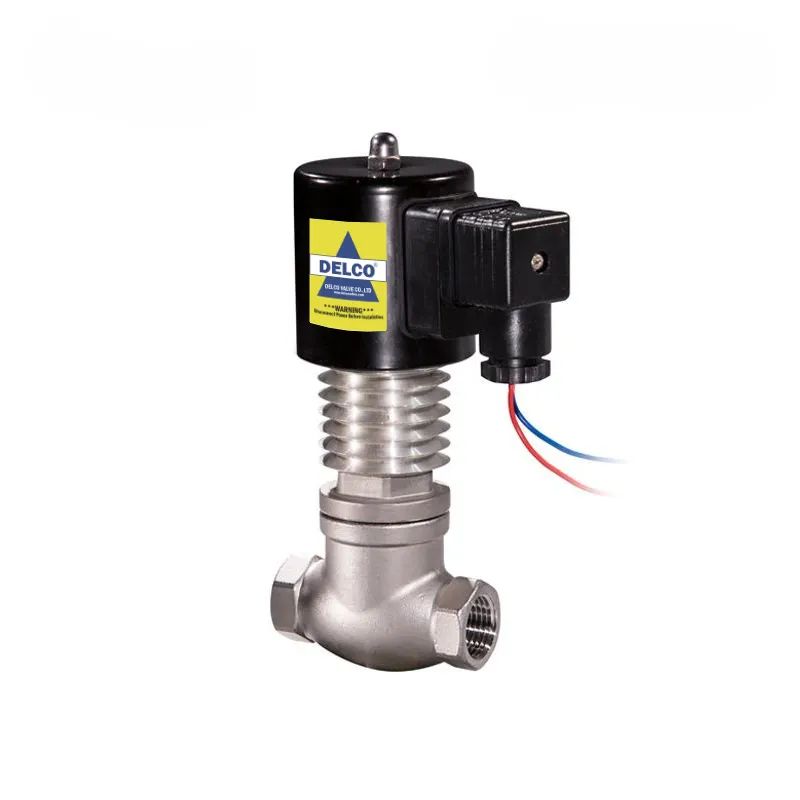
ZQDF SS Piston High Temp Steam Solenoid Valve DN15-DN100 200°C 40Bar | DELCO
 Size Range: DN15-DN100
Pressure Range: 0.3-40Bar
Max Temperature: 200℃
Voltage: AC/DC 12V/24V110V/220V
-

2W10B Series Piston Type High-Temperature Sanitary Solenoid Valve
Size Range: DN10-DN50
Pressure Range: 0-16Bar
Max Temperature: 180℃
Voltage: AC/DC 12V/24V110V/220V
High-Temperature Solenoid Valve: Extreme 250°C Steam & Thermal Fluid Automation
Engineered for industrial boiler steam distribution, vulcanization autoclaves, textile dyeing presses, and thermal oil heating loops, the Delco high-temperature solenoid valve series eliminates heat-induced coil failure and thermal binding. Featuring specialized radiation dissipation standoffs, Class H (180°C) and Class N (200°C) vacuum-potted coils, and thermal expansion-compensated PTFE or PEEK piston rings, these valves maintain bubble-tight shutoff across saturated steam, superheated steam, and heat transfer oils at temperatures up to 250°C (482°F) and pressures up to 1.6 MPa (16 bar).
Technical Merits: Thermal Engineering & High-Temperature Reliability
An extended bonnet with machined heat-dissipation fins separates the electrical coil from the hot valve body, keeping coil operating temperatures well below thermal breakdown limits.
Completely free of rubber elastomers that harden, bake, and crack in steam. All primary seals utilize virgin PTFE, carbon-reinforced R-PTFE, or virgin PEEK piston rings.
Engineered clearances and dynamic expansion compensation rings prevent the pilot piston from seizing inside the cylinder bore during rapid temperature spikes and cold-start transitions.
Wound with high-temperature enameled copper and vacuum-impregnated with high-conductivity epoxy, delivering 100% ED continuous energization without coil burnout or drop-out.
Pressure ratings up to 1.6 MPa (16 bar / 232 psi) easily cover industrial saturated steam networks (which operate at 1.0 MPa / 184°C), ensuring a wide safety operating margin.
Hardened 304/316L stainless steel internal pilot needles, armature tubes, and orifice seats resist high-velocity steam erosion (wire-drawing) and scale particle wear.
Technical Specifications Matrix
| Parameter | Saturated Steam Bronze | Superheated Steam WCB | High-Temp Stainless CF8M | Thermal Oil Extreme Class |
|---|---|---|---|---|
| Nominal Size Range | DN10 – DN50 (3/8" – 2") | DN15 – DN65 (1/2" – 2-1/2") | DN15 – DN100 (1/2" – 4") | DN15 – DN50 (1/2" – 2") |
| Operating Pressure | 0.1 – 1.6 MPa (1 – 16 Bar) | 0.1 – 1.6 MPa (Steam Service) | 0.1 – 2.5 MPa (Class 150/300) | 0.05 – 1.6 MPa (Thermal Fluid) |
| Body Construction | Cast Bronze RG5 / Forged Brass | Cast Carbon Steel A216 WCB | Cast Stainless ASTM A351 CF8M | Forged Steel A105 / CF8M |
| Sealing Trim Material | Virgin PTFE Piston Rings | Carbon-Filled PTFE / PEEK | Reinforced PEEK / Metal-to-Metal | Solid PEEK / Viton Extreme |
| Operating Temp Range | -10°C to +180°C (356°F) | -10°C to +250°C (482°F) | -20°C to +250°C (482°F) | -10°C to +300°C (572°F) |
| Actuation Architecture | Pilot Piston (ΔP ≥ 0.5 Bar) | Pilot Piston with Heat Standoff | Flanged Pilot Piston | Semi-Direct / Pilot Piston |
| End Connections | Female G (ISO 228-1) / NPT | Female NPT / ASME 150# Flange | RF Flanged (ASME B16.5 / EN) | Female NPT / Flanged PN25 |
| Coil Specifications | Class H (180°C) or Class N (200°C); 24VDC, 110VAC, 220VAC (50/60 Hz); IP65 DIN 43650 Form A; 100% ED Continuous Duty | |||
Frequently Asked Questions: High-Temperature Solenoid Valves
Q1: Why do standard solenoid valves fail when exposed to steam service?
Standard solenoid valves use elastomeric diaphragms (NBR or EPDM) and standard Class F (155°C) coils. At 150°C–180°C steam temperatures, rubber undergoes rapid vulcanization and hardening, resulting in brittle fractures and leakage within weeks. Concurrently, heat conducting up the stem into the coil destroys the wire varnish, causing inter-turn electrical shorting and coil burnout.
Q2: What is the purpose of the thermal isolation standoff (radiation neck)?
The thermal standoff is an elongated metallic neck featuring machined circumferential cooling fins situated between the valve body and the solenoid armature tube. It acts as a passive thermal barrier: ambient convection along the fins dissipates up to 60% of conducted heat, ensuring that coil operating temperatures remain well below their 180°C insulation rating even when 250°C steam flows through the body.
Q3: How do Delco valves prevent piston jamming caused by thermal expansion differences?
When steam lines start up, the internal piston heats up faster than the heavy body casting, causing differential thermal expansion. Conventional tight-fitting metal pistons seize in the bore. Delco incorporates precision-machined thermal expansion gaps sealed by flexible, self-lubricating PTFE/PEEK piston rings with internal stainless energizing springs, guaranteeing smooth travel during thermal transients.
Q4: What are the installation best practices for high-temperature steam solenoid valves?
To prevent steam condensate pooling and foreign scale accumulation, always install high-temperature solenoid valves in horizontal pipelines with the solenoid coil mounted strictly vertically upright. Additionally, installing a 100-mesh Y-strainer and a steam trap upstream prevents pipeline boiler scale and water hammer slugs from damaging the precision pilot orifice.
Direct Factory Supply: Heavy-Duty High-Temperature Solenoid Valves
High-capacity factory production of bronze, cast steel WCB, and 316 stainless steel high-temperature valves up to 250°C. 100% factory thermal-cycle tested, bubble-tight seat certified, and ready for immediate boiler and thermal oil skid integration.