



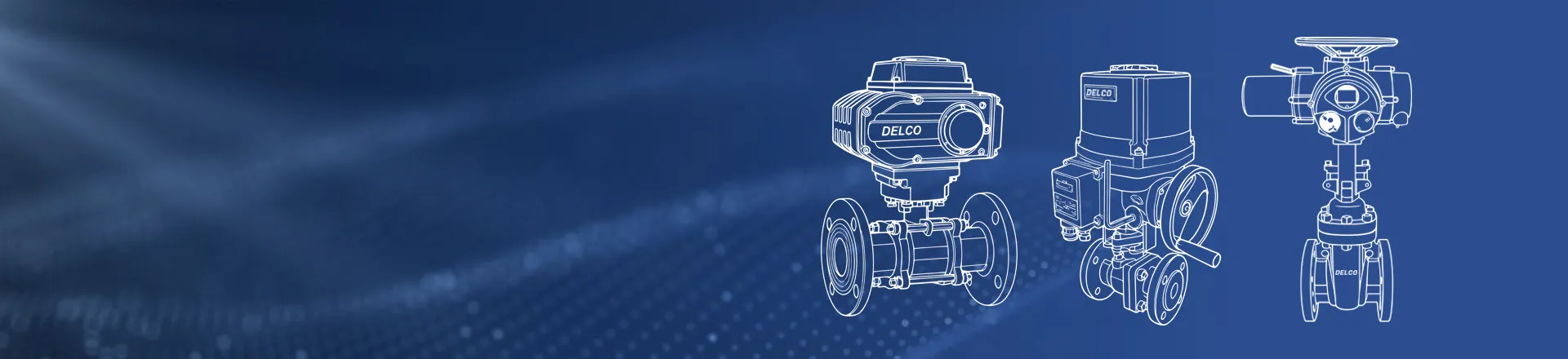
Electric Heating Jacket Ball Valves
Designed for viscous or temperature-sensitive fluids, DELCO Electric Heating Jacket Ball Valves prevent solidification. These motorized thermal valves maintain media temperature, ensuring smooth flow in asphalt, chocolate, and chemical processing lines.


Electric Heating Jacket Ball Valves (Steam & Thermal Oil Jacketed)
DELCO electric heating jacket ball valves are engineered to maintain process fluid temperatures, preventing media crystallization, coagulation, or severe viscosity increases that cause pipeline blockages. By welding a seamless metallic heating jacket over the valve body, heating media—such as saturated steam, heat transfer thermal oil, or hot water—circulates continuously around the entire valve cavity. As a high-performance configuration in the DELCO electric ball valves series, our jacketed valves are paired with high-temperature thermal dissipation brackets and intelligent electric actuators, delivering reliable automated isolation and throttling up to 350°C for bitumen, asphalt, molten sulfur, heavy polymers, and chemical resins.
Full Jacket Design (Oversized Flanges)
The heating jacket encapsulates the entire valve body from flange to flange, providing uniform thermal coverage with zero cold spots. Features end flanges sized one nominal step larger than the internal pipeline bore (e.g., 2" valve body with 3" connection flanges) to ensure full clearance for pipeline flange bolt insertion.
- Complete thermal coverage eliminates media freezing at the flange neck
- Standard jacket ports: 1/2" to 1" female NPT or flanged connections
- Best suited for high-crystallization fluids like molten sulfur and asphalt
Semi-Jacket Design (Standard Dimensions)
The jacket encapsulates the center cavity of the valve while preserving standard ASME B16.10 or DIN 3202 face-to-face dimensions and standard flange sizes. Designed as a direct drop-in replacement for tight pipeline spaces where piping cannot accommodate oversized flanges.
- 1:1 drop-in replacement without altering existing pipeline flange spacing
- Cost-effective thermal preservation for medium-viscosity resins and oils
- Compact profile reduces overall valve assembly weight and footprint
Why Engineers Specify DELCO Jacketed Ball Valves
Engineered with advanced thermal isolation, pressure relief mechanics, and rugged welding metallurgy to eliminate cold-spot plugging in extreme heat lines.
Zero Cold-Spot Thermal Envelope
Full-welded jacket chamber guarantees continuous thermal circulation around the ball, seat rings, and stem housing. Eliminates thermal bridging to prevent viscous media from solidifying or jamming the ball during idle operating shifts.
Thermal Stand-Off Actuator Bracket
Equipped with an extended high-temperature bonnet stand-off and convective cooling fins. Isolates high pipeline temperatures (up to 350°C), keeping actuator motor windings and electronic PCB boards below 60°C for long service life.
Cavity Over-Pressure Relief Hole
When trapped media inside the valve cavity is heated, extreme hydraulic thermal expansion can damage valve seats. DELCO incorporates an upstream pressure-balancing hole in the ball to vent cavity over-pressure safely into the line.
High-Temp PEEK & Metal-to-Metal Seats
Configured with virgin PEEK seats (up to 250°C) or Stellite hard-faced metal-to-metal seating (up to 350°C+). Maintains low operating torque and tight Class V/VI shut-off without seat deformation under severe thermal cycling.
Dual 100% Hydrostatic Pressure Testing
Both the inner valve body and the outer heating jacket undergo separate 100% hydrostatic shell and leak testing at 1.5 times design pressure. Eliminates cross-contamination risk between heating steam and internal chemical media.
High-Torque Anti-Seizure Actuation
Jacketed valves experience elevated breakaway torque upon cold restarts. DELCO automated packages feature electric actuators sized with 35% safety margins, electronic torque overload sensors, and manual declutchable handwheels.
Jacketed Valve Engineering Matrix & Specifications
Review standardized heating jacket parameters, oversized flange pairings, and high-temperature seating configurations.
| Jacket Capacity Class | Valve Bore x Flange Size | Jacket Rating & Medium | Valve Core Rating | Max Working Temp | Typical Process Media |
|---|---|---|---|---|---|
| Compact Steam Jacket Class | DN15 – DN40 (1/2" – 1-1/2") Flange: 1" – 2" (Oversized) |
1.6 MPa (PN16) / Steam | Class 150 / PN16 | Up to 200°C (392°F) | Resins, Adhesives, Food Fats |
| Mid-Bore Thermal Oil Class | DN50 – DN100 (2" – 4") Flange: 3" – 5" (Oversized) |
2.5 MPa (PN25) / Thermal Oil | Class 150 / 300 (PN40) | Up to 280°C (536°F) | Molten Sulfur, Liquid Polymers |
| Heavy-Duty Bitumen Class | DN125 – DN200 (5" – 8") Flange: 6" – 10" (Oversized) |
2.5 MPa (PN25) / Steam or Oil | Class 150 / 300 | Up to 350°C (662°F) | Bitumen, Asphalt, Coal Tar |
| Metal-Seated Severe Class | DN50 – DN200 (2" – 8") Flange: Oversized |
4.0 MPa (PN40) / High-Temp Oil | Class 300 / 600 | Up to 400°C (752°F) | Refinery Coking, Slurry, Urea |
| Semi-Jacket Retrofit Class | DN25 – DN150 (1" – 6") Flange: Standard Size |
1.6 MPa (PN16) / Steam | Class 150 / PN16 | Up to 220°C (428°F) | Compact Pipeline Retrofits |
Technical FAQs: Jacketed Ball Valve Automation
Essential engineering questions regarding oversized flanges, thermal actuator protection, and jacket pressure testing.
1. Why do full heating jacket ball valves require oversized pipe flanges?
Because a full heating jacket completely envelops the valve body and extends right to the back of the flange faces, the outer diameter of the jacket pipe is larger than the nominal valve bore. To allow standard flange bolts to pass through without interfering with the welded jacket shell, connection flanges are manufactured one size larger (e.g., a DN50 / 2" bore valve uses DN80 / 3" connection flanges). Pipe matching must follow the oversized flange dimensions.
2. How is the electric actuator protected from conductive heat up to 350°C?
Standard electric actuator motors and internal electronics have a maximum ambient operating limit of 60°C to 70°C. DELCO integrates an engineered thermal stand-off bracket column (100mm to 150mm extension) equipped with convective heat-dissipation fins between the valve ISO 5211 top pad and the actuator. This thermal barrier prevents direct conductive heat transfer, ensuring long-term actuator reliability.
3. What is the risk of trapped media thermal expansion, and how is it resolved?
When a jacketed ball valve closes, liquid media remains trapped inside the ball cavity. As continuous heat from the steam jacket transfers into this confined space, thermal expansion causes extreme hydraulic pressure spikes capable of crushing valve seats or deforming the ball. DELCO solves this by precision-drilling a cavity pressure relief hole on the upstream side of the ball, venting expansion forces safely into the pipeline.
4. How are jacket and valve body pressure tests verified before shipment?
Every DELCO jacketed valve undergoes dual-stage independent testing per API 598. First, the core valve body undergoes hydrostatic shell testing and bidirectional seat leakage testing. Second, the welded jacket chamber undergoes an independent hydrostatic test at 1.5 times the jacket design pressure to guarantee zero pinholes or cross-leakage between the thermal fluid and the pipeline process media.
Factory Direct Supply for Heating Jacketed Valves
Prevent pipeline freeze-ups with custom engineered jacketed automation packages. DELCO provides 100% dual hydrostatic pressure testing, custom jacket inlet/outlet orientations (NPT or flanged), high-temperature actuator sizing, and full CAD dimensional drawings for engineering projects worldwide.