



 Home / Solenoid Valve /

Anti-Corrosion Solenoid Valves
DELCO Anti-Corrosion Solenoid Valves are built to resist aggressive media. Using chemically inert materials like UPVC, PTFE (Teflon), or CPVC, these chemical-resistant valves effectively handle strong acids, alkalis, and seawater without degradation.


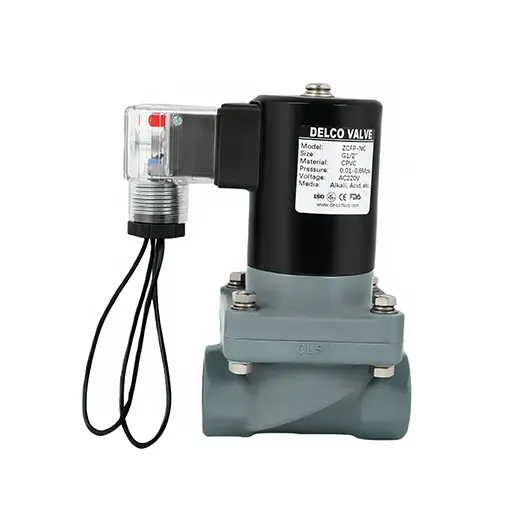

Anti-Corrosion Solenoid Valve: 100% Media-Isolated Acid & Chemical Automation
Engineered for chemical dosing skids, PCB electroplating baths, semiconductor acid delivery, and chlor-alkali neutralization loops, the Delco anti-corrosion solenoid valve series eliminates metallic corrosion and process contamination through complete media-isolation architecture. By isolating aggressive liquids from internal metallic plungers and springs using an impermeable fluoropolymer diaphragm, these valves provide bubble-tight shutoff across concentrated hydrochloric acid (HCl), sulfuric acid (H2SO4), nitric acid, and sodium hypochlorite (bleach) under reliable direct-acting electromagnetic control.
Technical Merits: Chemical Isolation & Reliability
An impermeable virgin PTFE or FKM isolating membrane completely seals off the electromagnetic core tube, preventing fluid contact with metallic plungers and springs.
All fluid-wetted components consist solely of virgin thermoplastics and fluoropolymers, preventing metal leaching and particulate contamination in high-purity chemical lines.
Direct-acting and pivoted rocker mechanisms lift the seal mechanically, ensuring reliable open/close cycling under zero line pressure, gravity drainage, and vacuum loops.
Streamlined internal chamber geometry eliminates dead pockets, preventing chemical crystallization and salt precipitation when metering sodium hypochlorite or brine.
Class H vacuum-impregnated epoxy coils endure non-stop energization in humid, aggressive acid fume environments without overheating or magnetic drop-off.
Double union nuts on UPVC and PVDF models allow the central valve body and coil assembly to be unthreaded from piping without cutting or disassembling solvent-welded lines.
Technical Specifications Matrix
| Parameter | PTFE Solid Billet | PVDF High-Purity | UPVC True Union | CPVC High-Temp |
|---|---|---|---|---|
| Nominal Size Range | DN3 – DN25 (1/8" – 1") | DN10 – DN50 (3/8" – 2") | DN15 – DN50 (1/2" – 2") | DN15 – DN50 (1/2" – 2") |
| Operating Pressure | 0 – 0.6 MPa (Zero ΔP) | 0 – 0.6 MPa (0 – 6 Bar) | 0 – 0.6 MPa (0 – 6 Bar) | 0 – 0.6 MPa (0 – 6 Bar) |
| Operating Temp Range | -20°C to +120°C (-4°F to 248°F) | -10°C to +100°C (14°F to 212°F) | -10°C to +60°C (14°F to 140°F) | -10°C to +90°C (14°F to 194°F) |
| Isolating Diaphragm | Virgin PTFE Membrane / Bellows | PTFE / FKM Composite | EPDM / FKM / PTFE | FKM / PTFE |
| Chemical Suitability | Universal (pH 0–14), Aqua Regia | Wet Cl2, Bromine, HF, UPW | Bleach, Dilute HCl, H2SO4, NaOH | Hot Plating Acid, Alkaline Wash |
| End Connection Styles | Female NPT / G Threaded | True Union Socket / Thread / Flange | True Union (DIN/ANSI Socket) | True Union (Socket / Thread) |
| Available Voltages | 12VDC, 24VDC, 110VAC, 220VAC (50/60 Hz); ±10% Voltage Tolerance; 100% ED Continuous Duty | |||
| Enclosure Protection | IP65 / IP67 DIN 43650 Form A Connector with LED indicator; Optional ATEX Ex-mb Encapsulated Coil | |||
Frequently Asked Questions: Anti-Corrosion Solenoid Valves
Q1: How does an isolating diaphragm protect the solenoid valve from aggressive acid failure?
In standard valves, process fluid fills the armature guide tube and contacts the stainless steel core and return spring. Even high-grade stainless steels corrode rapidly in hydrochloric acid or bleach. Delco’s isolating diaphragm creates a physical barrier: the magnetic plunger actuates the diaphragm from the dry side, so only the inert polymer body and diaphragm touch the acid.
Q2: Why are anti-corrosion solenoid valves rated to 0.6 MPa (6 Bar) rather than standard 1.6 MPa?
Thermoplastic bodies (UPVC, PVDF, PTFE) have lower tensile strength than cast metals. Furthermore, direct-acting diaphragm isolation designs require the coil’s magnetic pull to directly lift the flexible diaphragm against line pressure without pilot hole assistance. A 0.6 MPa (6 Bar / 87 psi) rating provides the optimum balance of coil safety, thermal life, and structural integrity.
Q3: Can these valves handle sodium hypochlorite (bleach) without sticking?
Yes. Sodium hypochlorite releases chlorine gas bubbles and deposits salt crystals that jam conventional valves. Delco’s anti-corrosion valves feature smooth, deadleg-free flow paths and resilient PTFE/FKM diaphragms that flex during each cycle, naturally dislodging salt crystallization and preventing plunger binding.
Q4: How do I choose between PTFE, PVDF, and UPVC body materials?
Select UPVC for economical ambient temperature (≤ 60°C) chemical dosing, wastewater treatment, and dilute acids. Select PVDF for higher temperatures (≤ 100°C), strong oxidizers like wet chlorine, ozone, or ultra-pure deionized water. Select PTFE for extreme universal chemical resistance (pH 0–14), aggressive mixed organic solvents, and concentrated nitric or hydrofluoric acids up to 120°C.
Direct Factory Supply: Chemical Anti-Corrosion Solenoid Valves
Delco stocks complete inventories of PTFE, PVDF, and UPVC media-isolated solenoid valves. 100% helium leak checked, bubble tested, and pre-fitted with Class H coils for immediate acid skid integration and worldwide shipment.