



Electric V-Port Ball Valves
DELCO Electric V-Port Ball Valves are designed for precise flow modulation. The specialized segmented V-notch ball allows for accurate linear flow characteristics, making these motorized control valves perfect for regulating slurry, fiber, and viscous fluids.


-
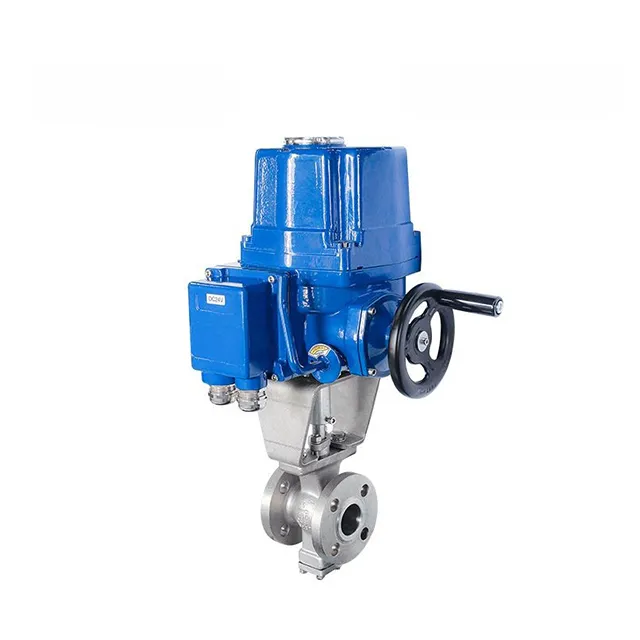
QT-DK55-VF Explosion-Proof Electric V-Port Flange Ball Valve - Modulating Control with Fiber Shearing Function
 Size Range: DN15-DN200
Material: WCB, Stainless Steel etc.
Connection Standard: GB / ANSI / JIS /DIN
-
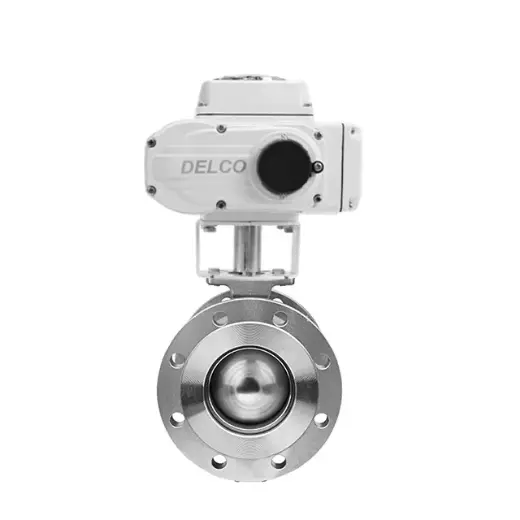
Electric V-Port Ball Valve | Flanged Modulating Control Valve | DELCO
Size Range: DN15-DN200
Material: WCB, Stainless Steel etc.
Connection Standard: GB / ANSI / JIS /DIN
Electric V-Port Segmented Ball Valves (Modulating Throttling & Slurry Shearing)
DELCO electric V-port segmented ball valves (also known as V-notch control valves) are high-precision process control units engineered for severe throttling, equal percentage flow modulation, and slurry shearing. Combining the high flow capacity (Cv) of a ball valve with the precise throttling rangeability of a globe control valve (up to 300:1 turndown ratio), the specially contoured V-notch ball creates a sharp shearing action against the seat as it rotates. As a specialized throttling series in the DELCO electric ball valve collection, our V-port valves slice cleanly through wood pulp fibers, mining tailings, abrasive slurries, and crystallizing liquids without clogging, guided by intelligent 4–20mA modulating electric actuators.
Custom V-Notch Angles (30°, 60° & 90°)
Tailored flow geometry engineered to match specific process loop characteristics. Choose 30° for ultra-precise micro-flow metering, 60° for balanced equal-percentage control across broad flow variations, or 90° for high-capacity slurry throughput with low head loss.
- 30° V-Port: Maximum precision for low-flow chemical dosing loops
- 60° V-Port: Industry standard for linear and equal-percentage throttling
- 90° V-Port: High flow throughput (Cv) with outstanding rangeability
Metal-to-Metal Hard-Faced Slurry Trim
Engineered for punishing erosive slurries in pulp & paper, mining, and chemical crystallization. The V-notch ball edge and flexible metallic seat are coated with supersonic HVOF Tungsten Carbide (WC-Co) or Stellite 6, withstanding severe abrasive wear and thermal shock up to 350°C.
- Sharp scissor-shearing action cuts through entangled fibrous slurries
- Spring-energized metal seat maintains constant wiping contact on the ball
- ANSI Class IV/V shut-off in abrasive slurry lines
Why Process Engineers Rely on DELCO V-Port Valves
Discover how our contoured V-port segment eliminates cavitating chatter, cuts entangled fibers, and delivers tight process loop control.
Scissor-Action Fibrous Shearing
As the segmented V-ball rotates into the seat, its razor-sharp V-notch edge generates a mechanical scissor effect against the seat ring. Slices cleanly through long wood fibers, textile pulp, and mineral solids, preventing jamming.
300:1 Broad Rangeability
Unlike standard full-bore ball valves that suffer erratic flow surges below 20% travel, DELCO V-port geometry provides smooth, predictable equal-percentage flow across a wide 300:1 turndown ratio, eliminating control loop hunting.
Splined Zero-Backlash Stem Drive
The valve shaft connects to the V-segment ball via a precision-machined involute spline or heavy keyed coupling. Eliminates mechanical play, hysteresis, and deadband during minute 4–20mA positioning adjustments.
Self-Cleaning Seat Chamber
The straight-through flow path avoids internal crevices where slurries can settle. Spring-loaded seat design maintains continuous contact with the ball, constantly wiping away scale, viscous polymers, and grit upon every cycle.
High-Resolution Digital Servo Actuator
Equipped with smart electric modulating actuators offering ±0.5% positioning accuracy, contactless absolute encoders, local LCD menu setup, and bus communication (Modbus RTU, Profibus DP, HART) for automated DCS integration.
Cavitation & Noise Attenuation Trim
For high differential-pressure gas and liquid lines, optional multi-hole attenuating baffle plates reduce hydrodynamic cavitation, acoustic noise, and vibration, protecting downstream piping from erosion.
V-Port Control Valve Engineering Matrix & Sizing
Review standardized V-notch angles, body materials, pressure classes, and typical process throttling services.
| Control Capacity Class | Size Range | V-Notch Angle | Pressure Rating | Seat & Trim Material | Typical Slurry / Flow Services |
|---|---|---|---|---|---|
| Micro-Metering V-Port Class | DN25 – DN50 (1" – 2") | 30° V-Notch | Class 150 / 300 (PN16–40) | Reinforced PTFE / PEEK | Fine Chemical Additive Dosing, Acid Metering |
| Standard Process Control Class | DN50 – DN200 (2" – 8") | 60° V-Notch | Class 150 / 300 (PN16–40) | RTFE or Metal-Seated | Wastewater Effluent, Cooling Water Loops |
| Pulp & Paper Slurry Class | DN80 – DN300 (3" – 12") | 60° or 90° V-Notch | Class 150 / PN16 | Stellite 6 / 316SS Hardened | Wood Pulp Stock (up to 8% consistency), Fibers |
| Heavy Abrasive Mining Class | DN100 – DN400 (4" – 16") | 60° / 90° Heavy Notch | Class 150 / 300 / 600 | Tungsten Carbide (HVOF) | Mineral Tailings, Fly Ash, Lime Slurry |
| High-Capacity Wafer V-Port | DN50 – DN250 (2" – 10") | 90° Wide V-Notch | Class 150 / PN16 | Metal or Soft-Seated | Space-Constrained Skids, Gas Throttling |
Technical FAQs: V-Port Control Valve Automation
Critical process engineering answers regarding V-notch angles, slurry shearing, and rangeability.
1. How does a V-port ball valve cut through fibrous slurries without jamming?
Standard full-port ball valves pinch fibers between round metal surfaces, causing fibrous material to wedge, de-water, and pack tightly until the valve jams. DELCO V-port segmented balls feature a precision-ground, razor-sharp V-notch contour. When closing, the V-edge works against the flexible metal seat like a pair of high-speed scissors, shearing long cellulose fibers, paper stock, and crystalline slurries cleanly upon every cycle.
2. How do I select the optimal V-notch angle (30° vs. 60° vs. 90°)?
• 30° V-Notch: Best for tight, micro-metering applications where fine flow increments are required at small valve openings (chemical additives, acid dosing).
• 60° V-Notch: The universal industry standard; delivers an ideal equal-percentage flow curve with a balance between broad throttling rangeability and throughput.
• 90° V-Notch: Delivers maximum flow capacity (Cv) while retaining precise throttling at lower openings; perfect for heavy slurries, lime milk, and high-volume drainage.
3. Why are V-port segmented ball valves replacing traditional globe control valves?
Traditional globe control valves have a tortuous, S-shaped flow path with small flow passages that easily clog, erode, and cause high pressure drops in dirty fluid service. V-port segmented valves feature a straight-through flow path offering 2 to 3 times higher flow capacity (Cv) for the same nominal pipe size, superior slurry handling, and a much more compact physical profile at lower capital cost.
4. What prevents positioning hysteresis in automated DCS control loops?
In modulating control, loose mechanical couplings create deadband and hunting (overshoot/undershoot). DELCO pairs V-port valves with zero-backlash splined drive shafts and digital servo actuators. An internal non-contact magnetic encoder continuously measures true ball shaft angle with ±0.5% repeatability, ensuring instantaneous response to minute 4–20mA analog control signals.
Factory Direct Supply for V-Port Modulating Valves
Master difficult process throttling with custom engineered V-port segmented valves. DELCO provides customized Cv flow calculations, Tungsten Carbide slurry trims, 4–20mA digital actuator calibration, and full CAD documentation for engineering contractors worldwide.