




Pneumatic V-Port Segmented Ball Valves
DELCO Pneumatic V-Port Segmented Ball Valves are engineered for precise flow throttling and modulation. Featuring a specialized V-notch ball with shearing action, these air-operated control valves effectively cut through fibers and solids, making them the ideal solution for pulp, paper, and wastewater slurry applications.


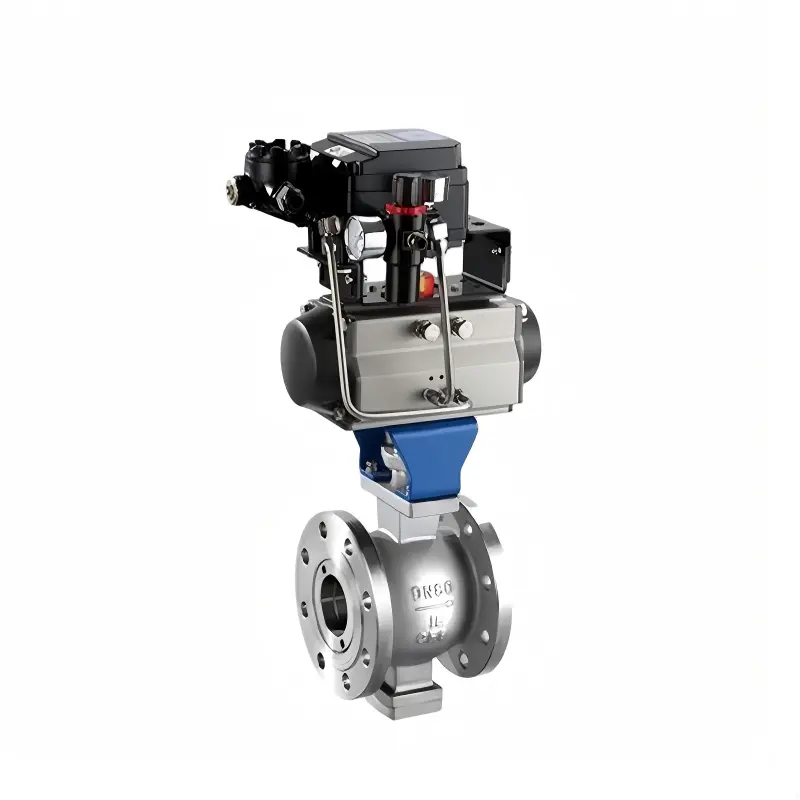

Pneumatic V-Port Segmented Ball Valve: Precision Throttling & Slurry Shearing
Designed for demanding modulating control in pulp and paper processing, mining slurries, chemical reactor dosing, and wastewater aeration, the Delco pneumatic ball valve V-port segmented series combines the high flow capacity of a rotary ball with the precision control of a globe valve. The contoured V-notch ball segment creates a self-cleaning scissor shearing action against metal or resilient seats, delivering a 300:1 turndown ratio and an equal percentage flow characteristic without clogging on entrained solids.
Technical Merits: Rotary Control Valve Engineering
The mathematical geometry of the V-notch orifice delivers superior rangeability up to 300:1, outperforming conventional globe valves in dynamic industrial flow control.
As the V-ball rotates into the seat, it acts as a mechanical scissor, cleanly shearing fibers, wood chips, and scale deposits to prevent seat jamming or dewatering.
A splined or precision keyed drive connection between the actuator shaft and ball segment guarantees deadband-free response to minuscule 4-20mA control signals.
Equipped with digital smart positioners (HART, Profibus, Foundation Fieldbus) featuring autocalibration, online diagnostics, and steady-state air consumption under 0.01 Nm³/h.
The segmented ball is rigidly guided by upper and lower low-friction self-lubricating trunnion bearings, absorbing dynamic fluid forces across high pressure drops.
The unobstructed straight-through body geometry generates significantly higher Cv values than equivalent globe valves, permitting downsized valve selections.
V-Port Segmented Valve Engineering Specifications
| Parameter | Soft Seated Control Class | Metal Hard-Faced Slurry Class | Severe Service Stellite Class |
|---|---|---|---|
| Nominal Size Range | DN25 – DN300 (1" – 12") | DN25 – DN300 (1" – 12") | DN25 – DN250 (1" – 10") |
| Pressure Rating | ASME Class 150 / 300; PN16 / PN40 | ASME Class 150 / 300; PN16 / PN40 | ASME Class 300 / 600; PN40 / PN100 |
| Body Construction | WCB Carbon Steel / CF8M 316 SS | ASTM A351 CF8M / CF8C / WCB | CF8M / Hastelloy C276 / Duplex 2205 |
| Segment Trim Profile | 30°, 60°, or 90° V-Notch (Hard Chrome) | Hard Chrome Plated / Nickel Boride Plated | Stellite #6 Overlay / Tungsten Carbide HVOF |
| Seat Ring Material | Reinforced PTFE / PEEK / Devlon | 316 SS + Stellite Hard Facing | Solid Tungsten Carbide / Stellite |
| Leakage Class (FCI 70-2) | Class VI (Bubble Tight) | Class IV / Class V | Class IV / Class V |
| Operating Temp Range | -29°C to +180°C (-20°F to 356°F) | -29°C to +260°C (-20°F to 500°F) | -29°C to +350°C (-20°F to 662°F) |
| End Connection Styles | Flangeless Wafer (Universal ASME/DIN) or Integral Raised Face Flanged (ASME B16.5 / EN 1092-1) | ||
| Modulating Pneumatic Control | Double-Acting / Spring-Return Actuator + Smart EP Positioner (4-20mA, HART / Profibus-PA feedback, Air Filter Regulator) | ||
Frequently Asked Questions: V-Port Segmented Ball Valves
Q1: How does a V-notch ball valve provide equal percentage flow control?
The geometric shape of the V-notch creates an orifice opening where the area increases exponentially rather than linearly as the ball rotates. At small travel percentages (10%–30%), the opening expands slowly for ultra-fine flow throttling; at higher travel percentages, the orifice expands rapidly to provide large, unconstrained volumetric flow.
Q2: Why are segmented ball valves superior to globe valves in pulp and slurry services?
Globe valves feature tortuous S-shaped flow paths that cause suspended solids and wood fibers to accumulate under the plug, creating flow blockages and preventing shutoff. The V-port valve offers a completely unobstructed straight-through flow path and utilizes the V-segment edge as a shearing blade to slice cleanly through solids.
Q3: How do you select between 30°, 60°, and 90° V-notch segments?
Select 30° for low-flow chemical dosing or high-pressure drop loops requiring precise resolution at small openings. Select 60° for balanced general chemical and petrochemical modulating control. Select 90° when maximum Cv capacity and wide-open efficiency are required for heavy slurry and bulk fluid transportation.
Q4: What makes the pneumatic actuator linkage critical for modulating control?
In modulating service with a smart 4-20mA positioner, any mechanical tolerance play or backlash in the stem-to-actuator coupling causes hunting, deadband, and control oscillation. Delco utilizes pre-loaded splined or tight-tolerance keyed shaft connections to ensure micro-step positional commands translate directly to ball rotation.
Direct Factory Supply: High-Turndown Pneumatic V-Port Control Valves
Engineered rotary throttling packages assembled with smart electro-pneumatic positioners. 100% factory dynamic flow calibrated, FCI 70-2 seat leak certified, and delivered with full Cv curves for seamless DCS integration.