



Temperature Control Valves
DELCO Temperature Control Valves are designed to maintain constant process temperatures in heating and cooling systems. Whether utilizing electric actuation or self-acting thermal sensors, our valves ensure optimal heat exchange efficiency and equipment protection.


-
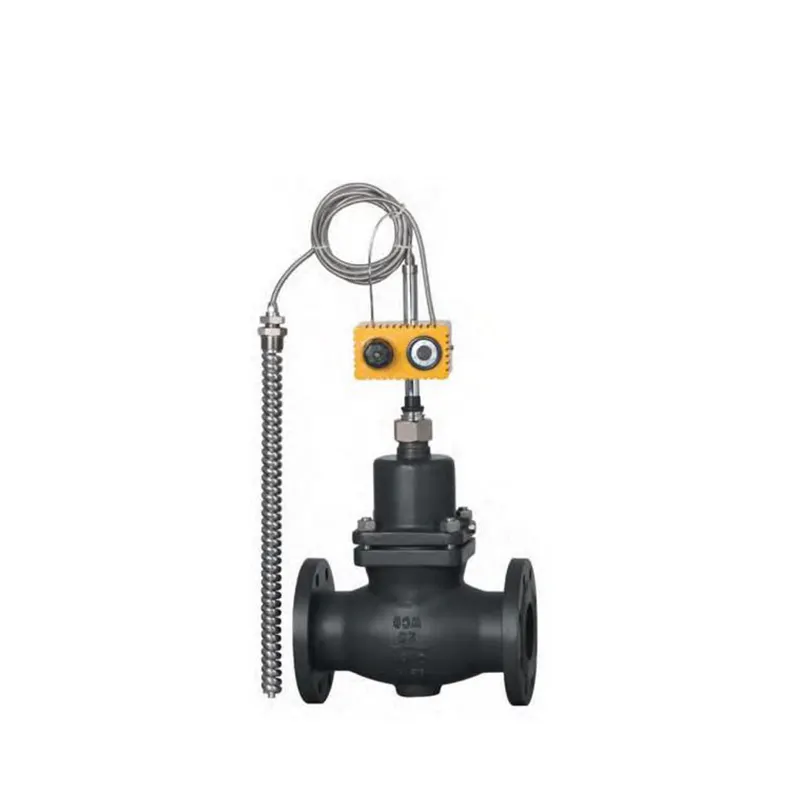
DELCO Self-operated Temperature Control Valve - Bellows Balanced, No External Power
 Size Range: DN15-DN600
Material: WCB,Stainless Steel etc.
Connection Standard: GB / ANSI / JIS / DIN
-
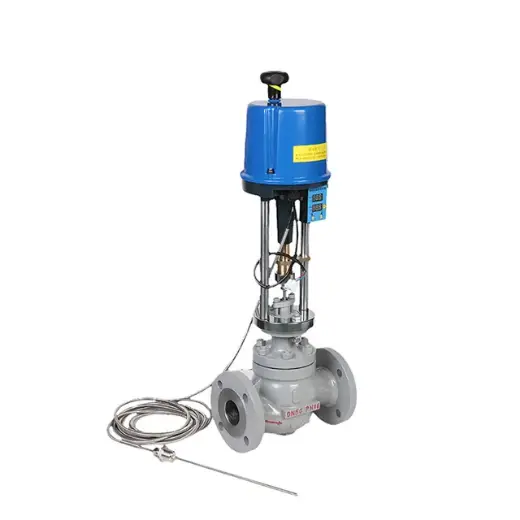
ZZWPE Series Electric Temperature Control Valve for High-Precision Regulation
Size Range: DN15-DN600
Material: WCB,Stainless Steel etc.
Connection Standard: GB/ANSI/JIS/DIN
Temperature Control Valve: Autonomous Thermostatic & Electronic Thermal Modulation
Engineered to maintain strict thermal stability across industrial heat exchangers, district heating substations, boiler economizers, and marine engine cooling jackets, the Delco temperature control globe control valve series provides continuous, proportional fluid regulation. Available in autonomous self-operating capillary formats that require zero external power as well as smart electronic RTD sensor-driven linear formats, these valves eliminate thermal cycling stress and optimize energy efficiency in 2-way throttling and 3-way mixing/diverting configurations.
Technical Merits: Thermal Control & Fluid Balancing
Thermostatic capillary models utilize volumetric expansion of specialized thermal liquids to directly stroke the valve, guaranteeing continuous thermal protection during power outages.
Two-way models provide linear equal-percentage steam/water throttling, while three-way models deliver complementary port opening to maintain constant overall hydraulic circulation.
An internal excess-temperature safety spring absorbs thermal fluid over-expansion during process surges, protecting the actuator bellows and mechanical linkages from over-stroke rupture.
Copper or stainless steel sensing bulbs fitted into precision thermowells achieve fast heat transfer, detecting process temperature shifts within seconds to eliminate thermal overshoot.
Balanced internal trim or metal bellows cancels hydraulic differential forces across the plug, preventing fluctuating inlet line pressure from disrupting calibrated thermal setpoints.
Flexible stainless steel armored capillary tubing extends up to 15 meters, enabling remote sensor installation inside pipelines or tank baths located far from the valve body.
Technical Specifications Matrix
| Parameter | Thermostatic 2-Way Throttling | Thermostatic 3-Way Mix/Divert | Electronic RTD Linear Class | Engine Cooling Wax Class |
|---|---|---|---|---|
| Nominal Size Range | DN15 – DN200 (1/2" – 8") | DN20 – DN250 (3/4" – 10") | DN15 – DN300 (1/2" – 12") | DN25 – DN200 (1" – 8") |
| Pressure Classes | PN16 / PN25 / Class 150 | PN16 / PN25 / Class 150 | Class 150 – 300 (PN16 – PN40) | PN10 / PN16 / Class 150 |
| Body Construction | Ductile Iron, WCB, CF8M, Bronze | Ductile Iron GGG40.3, WCB, CF8M | WCB, CF8M, WC6 Alloy | Ductile Iron, Bronze, CF8M |
| Temperature Setpoint Span | 0°C to +150°C (Multiple spans) | 0°C to +150°C | -20°C to +250°C (Programmable) | +35°C to +95°C (Fixed element) |
| Sensing & Actuation Mode | Liquid thermal bulb + capillary | Liquid thermal bulb + capillary | PT100 RTD + 24V/220V Linear Electric | Internal wax thermostatic element |
| Control Precision | ±1.0°C to ±2.0°C | ±1.5°C to ±2.0°C | ±0.2°C to ±0.5°C | ±2.0°C |
| Capillary Armored Length | 3m, 5m, 10m, 15m Stainless Armored | 3m, 5m, 10m Armored | Electric Signal Cable (Up to 100m) | Direct-immersion (No capillary) |
| Leakage (ANSI/FCI 70-2) | Class IV (Metal) / VI (Soft Seat) | Class IV (Metal Seated) | Class IV / Class VI | Class II / Class III (Bypass slip) |
| End Connection Styles | Flanged (ASME B16.5 / EN 1092-1), Female Threaded NPT/BSPT (Small sizes DN15–DN50) | |||
Frequently Asked Questions: Temperature Control Valves
Q1: What is the fundamental difference between a 3-way mixing valve and a 3-way diverting valve?
A Mixing Valve has two inlet ports (hot and cold water) and one common blended outlet port; the plug moves between the seats to blend temperatures proportionally. A Diverting Valve has one single inlet port and two outlet ports, routing process fluid either through a heat exchanger or around a bypass line. Installing a mixing valve in a diverting application can cause severe hydraulic slamming and premature seat wear due to reverse flow impingement.
Q2: How does a self-operated thermostatic valve operate without electrical power?
The system operates on thermodynamic fluid expansion principles. An immersion bulb contains a temperature-sensitive liquid. As process temperature rises, the liquid expands proportionally, pushing hydraulic volume through the armored capillary tube into an actuator bellows chamber. The expanding bellows exerts linear thrust on the valve stem, overcoming the setpoint return spring to modulate flow without power wiring.
Q3: When should an electronic RTD-coupled valve be chosen over a mechanical capillary valve?
Thermostatic capillary valves are favored for utility loops, remote equipment, and fail-safe blackouts due to zero power needs. However, electronic RTD-coupled valves are mandatory when temperature control tolerances must remain within ±0.2°C, when setpoints need remote adjustment via DCS/SCADA networks, or when distance between the sensor and valve exceeds 15 meters.
Q4: What prevents the thermal expansion actuator from rupturing during an over-temperature excursion?
If system temperature spikes well above the setpoint range, liquid continues to expand after the valve has reached full mechanical travel. Delco’s thermostatic actuators incorporate an internal heavy over-travel safety spring. When the plug bottoms out, this excess volume compresses the safety spring rather than rupturing the metal actuator bellows or capillary tubing.
Direct Factory Supply: Precision Temperature Control Valves
Delco supplies autonomous thermostatic and electronic temperature control valves in 2-way and 3-way designs. 100% factory water-bath calibrated, seat leak tested, and delivered complete with thermowells and armored capillaries for immediate heat exchange integration.