



Vannes de contrôle de température
DELCO supplies 2-way and 3-way industrial temperature control valves (DN15–DN600, -20°C à 250°C) pour la vapeur, Chauffage, Refroidissement, and heat-exchange pipelines. Available in self-operated thermostatic and electric RTD/PID modulating designs for stable thermal regulation and equipment protection.


-
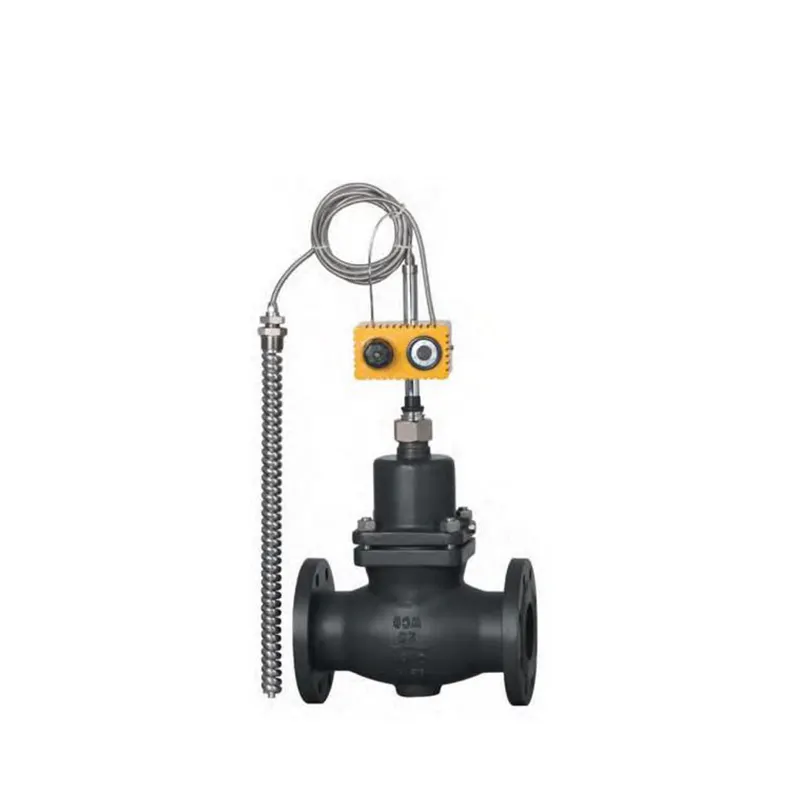
Vanne de contrôle de température autonome DELCO - Soufflets équilibrés, Pas d’alimentation externe
 Gamme de taille: DN15-DN600
Matériel: WCB,Acier inoxydable, etc..
Norme de connexion: GB / ANSI / JIS / DIN
-
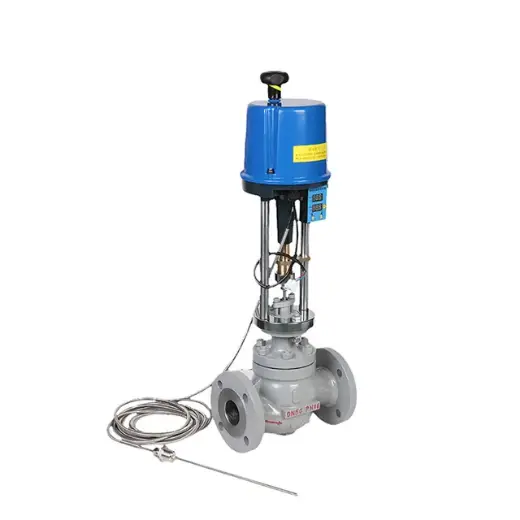
Vanne de régulation de température électrique série ZZWPE pour une régulation de haute précision
Gamme de taille: DN15-DN600
Matériel: WCB,Acier inoxydable, etc..
Norme de connexion: GB/ANC/GIS/JOUR
Vanne de contrôle de température: Thermostatique autonome & Modulation thermique électronique
Conçu pour maintenir une stabilité thermique stricte sur les échangeurs de chaleur industriels, steam heating coils, Postes de chauffage urbain, Économiseurs de chaudières, and process cooling pipelines, the DELCO temperature control valve lineup—built on proven Soupape de contrôle à globe architectures—provides continuous, Régulation proportionnelle des fluides. Available in self-operated thermostatic designs requiring zero external power as well as RTD sensor-driven electric modulating designs, these valves minimize thermal cycling stress and optimize energy efficiency in 2-way throttling and 3-way mixing/diverting loops.
Mérites techniques: Contrôle thermique & Équilibrage des fluides
Self-operated thermostatic models utilize volumetric expansion of specialized thermal liquids to directly stroke the valve, maintaining continuous thermal regulation during power outages.
Two-way models provide linear or equal-percentage steam/water throttling, tandis que les modèles à trois voies offrent une ouverture complémentaire des orifices pour maintenir une circulation hydraulique globale constante.
Un ressort de sécurité interne en surchauffe la surexpansion du fluide thermique lors des surtensions du procédé, protecting the actuator bellows and mechanical linkages from over-stroke damage.
Copper or stainless steel sensing bulbs fitted into precision thermowells ensure fast heat transfer, responding quickly to process temperature shifts to minimize thermal overshoot.
Balanced internal trim or metal bellows offsets differential pressure forces across the plug, Empêcher que la pression fluctuante de la ligne d’admission ne perturbe les points de consigne thermiques calibrés.
Flexible stainless steel armored capillary tubing extends up to 10 meters (custom up to 15m on request), enabling remote sensor installation inside pipelines or tank baths away from the valve body.
Matrice des spécifications techniques
| Paramètre | Self-Operated 2-Way (Strangulation)* | Self-Operated 3-Way (Mixage / Détournement) | Electric Modulating (À 2 voies & Trois voies, RTD/PID) |
|---|---|---|---|
| Plage de taille nominale | DN15 – DN200 (1/2" – 8") | DN20 – DN250 (3/4" – 10") | DN15 – DN300 (1/2" – 12") |
| Classes de pression | PN16 / PN25 / Classe 150 | PN16 / PN25 / Classe 150 | PN16 / PN25 / PN40 / Class 150 / Class 300 |
| Matériau de la carrosserie | Fonte ductile (EN-GJS-400), Bronze, WCB, CF8M | Fonte ductile (EN-GJS-400), WCB, CF8M | WCB, CF8M |
| Temperature Setpoint Range | 0De °C à 150°C (Multiple selectable spans) | 0De °C à 150°C (Multiple selectable spans) | -20°C à 250°C (Programmable) |
| Détection & Mode d’actionnement | Capillaire à ampoule thermique liquide | Capillaire à ampoule thermique liquide | PT100 RTD + PID Controller + Linear Electric Actuator (24V AC/DC, 110–230V AC) |
| Précision de contrôle | ±1.5°C to ±2.5°C (Steady load) | ±1.5°C to ±2.5°C (Steady load) | ±0.5°C to ±1.0°C (RTD class & loop dependent) |
| Sensor Connection / Capillary Length | 3m, 5m, 10m Stainless Armored (15m on request) | 3m, 5m, 10m Stainless Armored | 3-Wire Shielded RTD / 4–20mA Signal Cable (Jusqu’à 100 m) |
| Fuite (ANSI/FCI 70-2) | Classe IV (Métal) / Classe VI (Siège souple, media ≤180°C) | Class III / Class IV (Assis en métal) | Classe IV (Métal) / Classe VI (Siège souple, media ≤180°C) |
| Styles de connexion à l’extrémité | Bride (ASME B16.5/B16.42/B16.24, EN 1092-1/-2/-3); Threaded NPT/BSPT (DN15–DN50) | Bride (ASME B16.5/B16.42, EN 1092-1/-2); Threaded NPT/BSPT (DN20–DN50) | Bride (ASME B16.5 / EN 1092-1); Threaded / SW (DN15–DN50) |
Questions fréquemment posées: Vannes de contrôle de température
Q1: Quelle est la différence fondamentale entre une vanne mélangeuse à 3 voies et une vanne à déviation à 3 voies?
A Valve de mélange possède deux orifices d’entrée (Par exemple,, hot and cold fluid streams) et un port de sortie blended courant; Le bouchon se déplace entre les sièges pour équilibrer les températures proportionnellement. A Soupape de déviation has a single inlet port and two outlet ports, Acheminement du fluide du procédé soit via un échangeur de chaleur, soit autour d’une ligne de dérivation. In 3-way globe control valves, installing a mixing trim in a diverting application can cause hydraulic slamming and premature seat wear due to reverse flow forces.
Q2: Comment une vanne thermostatique autonome fonctionne-t-elle sans alimentation électrique?
The system operates on liquid thermal expansion principles. An immersion sensing bulb is filled with a temperature-sensitive liquid. Lorsque la température du procédé augmente, le liquide se dilate proportionnellement, displacing incompressible fluid through the armored capillary tube into an actuator bellows chamber. Le soufflet expansif exerce une poussée linéaire sur la tige de la soupape, overcoming the setpoint return spring to modulate flow with zero external power wiring.
Q3: When should an electric RTD-coupled valve be chosen over a self-operated thermostatic valve?
Self-operated thermostatic valves are favored for utility loops, Équipement à distance, and continuous operation during power outages due to their zero-power design. Electric RTD/PID modulating valves are recommended when process control tolerances must stay within ±0.5°C to ±1.0°C, when setpoints require remote adjustment via DCS/SCADA networks, or when the distance between the sensor and valve exceeds 10–15 meters.
Q4: Qu’est-ce qui empêche l’actionneur de dilatation thermique de se rompre lors d’une excursion sur-température ??
Si la température du système dépasse largement la plage de consigne, the thermal liquid continues to expand even after the valve reaches full mechanical travel. DELCO’s thermostatic actuators incorporate an internal heavy-duty over-travel safety spring. Once the valve reaches its full travel limit, this excess fluid volume compresses the safety spring rather than rupturing the metal actuator bellows or capillary tubing.
Approvisionnement direct en usine: Vannes de contrôle de température de précision
DELCO supplies self-operated thermostatic and electric RTD/PID temperature control valves in 2-way and 3-way designs. 100% factory temperature-calibrated, Testé pour fuite de siège, and available with matched thermowells, armored capillaries, or PID control assemblies for direct industrial pipeline integration.