



Temperaturkontrollventile
DELCO supplies 2-way and 3-way industrial temperature control valves (DN15–DN600, -20°C bis 250°C) für Dampf, Heizung, Kühlung, and heat-exchange pipelines. Available in self-operated thermostatic and electric RTD/PID modulating designs for stable thermal regulation and equipment protection.


-
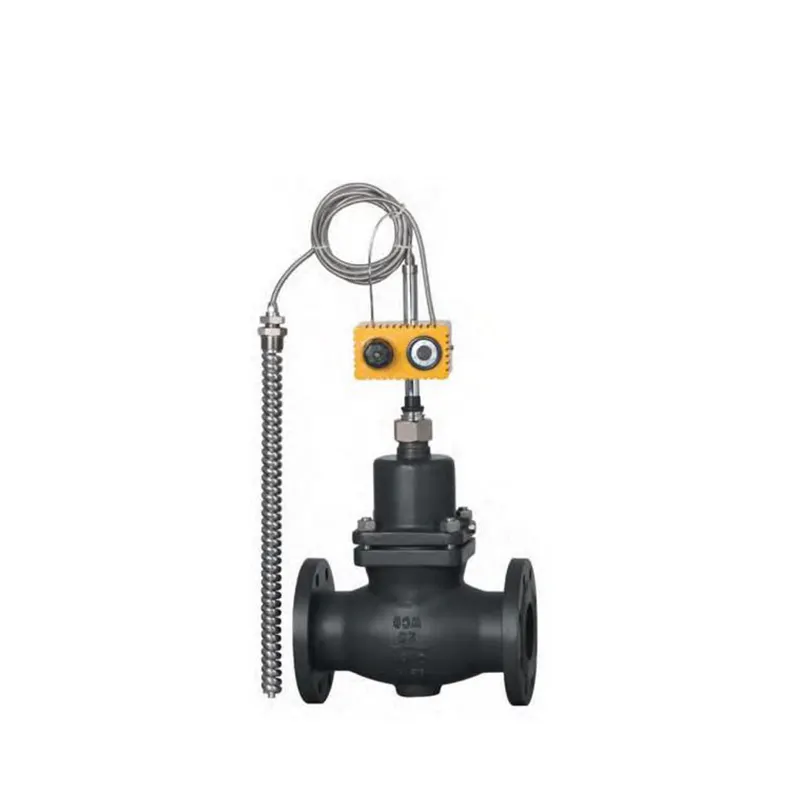
DELCO selbstbetriebenes Temperaturkontrollventil - Ausbalancierte Balgebalg, Keine externe Stromversorgung
 Größenbereich: DN15-DN600
Material: WCB,Edelstahl usw..
Verbindungsstandard: GB/ Ansi / Schräge Form von wer/ Tagesperiode rund um die Uhr
-
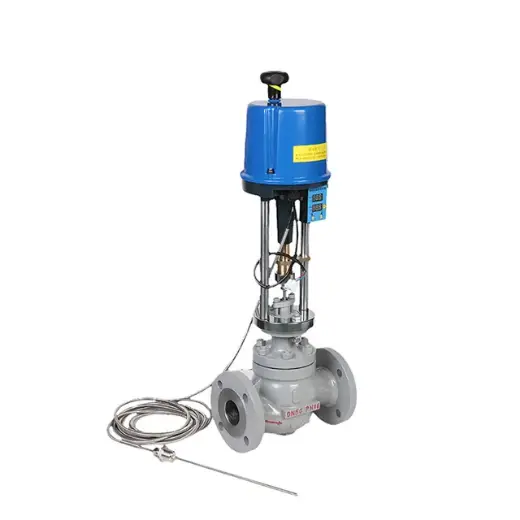
Elektrisches Temperierventil der ZZWPE-Serie für eine hochpräzise Regelung
Größenbereich: DN15-DN600
Material: WCB,Edelstahl usw..
Verbindungsstandard: GB/ANC/GIS/DAY
Temperaturregelventil: Autonomer Thermostat & Elektronische thermische Modulation
Entwickelt, um eine strikte thermische Stabilität über industrielle Wärmetauscher zu gewährleisten, steam heating coils, Umspannwerke der Fernwärme, Kesselökonomisierer, and process cooling pipelines, the DELCO temperature control valve lineup—built on proven Globusregelventil architectures—provides continuous, proportionale Flüssigkeitsregulation. Available in self-operated thermostatic designs requiring zero external power as well as RTD sensor-driven electric modulating designs, these valves minimize thermal cycling stress and optimize energy efficiency in 2-way throttling and 3-way mixing/diverting loops.
Technische Vorzüge: Wärmeregelung & Flüssigkeitsausgleich
Self-operated thermostatic models utilize volumetric expansion of specialized thermal liquids to directly stroke the valve, maintaining continuous thermal regulation during power outages.
Two-way models provide linear or equal-percentage steam/water throttling, während Dreifachmodelle eine komplementäre Öffnung des Ports bieten, um eine konstante hydraulische Zirkulation zu gewährleisten.
Eine interne Übertemperatur-Sicherheitsfeder absorbiert während der Prozessüberschüsse die Überexpansion der thermischen Flüssigkeit, protecting the actuator bellows and mechanical linkages from over-stroke damage.
Copper or stainless steel sensing bulbs fitted into precision thermowells ensure fast heat transfer, responding quickly to process temperature shifts to minimize thermal overshoot.
Balanced internal trim or metal bellows offsets differential pressure forces across the plug, Verhindern, dass schwankender Einlassdruck die kalibrierten thermischen Sollwerte stört.
Flexible stainless steel armored capillary tubing extends up to 10 meters (custom up to 15m on request), enabling remote sensor installation inside pipelines or tank baths away from the valve body.
Technische Spezifikationsmatrix
| Parameter | Self-Operated 2-Way (Drosselnd)* | Self-Operated 3-Way (Mischen / Umleitung) | Electric Modulating (2-Wege-Modus & 3-Way, RTD/PID) |
|---|---|---|---|
| Nominale Größenspanne | DN15 – DN200 (1/2" – 8") | DN20 – DN250 (3/4" – 10") | DN15 – DN300 (1/2" – 12") |
| Druckklassen | PN16 / PN25 / Baureihe 150 | PN16 / PN25 / Baureihe 150 | PN16 / PN25 / PN40 / Class 150 / Class 300 |
| Karosseriematerial | Duktiles Eisen (EN-GJS-400), Bronze, WCB, CF8M | Duktiles Eisen (EN-GJS-400), WCB, CF8M | WCB, CF8M |
| Temperature Setpoint Range | 0°C bis 150°C (Multiple selectable spans) | 0°C bis 150°C (Multiple selectable spans) | -20°C bis 250°C (Programmierbar) |
| Wahrnehmung & Aktuierungsmodus | Kapillare der flüssigen thermischen Bulb | Kapillare der flüssigen thermischen Bulb | PT100 RTD + PID Controller + Linear Electric Actuator (24V AC/DC, 110–230V AC) |
| Steuerungspräzision | ±1.5°C to ±2.5°C (Steady load) | ±1.5°C to ±2.5°C (Steady load) | ±0.5°C to ±1.0°C (RTD class & loop dependent) |
| Sensor Connection / Capillary Length | 3m, 5m, 10m Stainless Armored (15m on request) | 3m, 5m, 10m Stainless Armored | 3-Wire Shielded RTD / 4–20mA Signal Cable (Bis zu 100 m) |
| Leckage (ANSI/FCI 70-2) | Klasse IV (Metall) / Klasse VI (Weicher Sitz, media ≤180°C) | Class III / Class IV (Metallsitzend) | Klasse IV (Metall) / Klasse VI (Weicher Sitz, media ≤180°C) |
| Endverbindungsstile | Angeflanscht (ASME B16.5/B16.42/B16.24, EN 1092-1/-2/-3); Threaded NPT/BSPT (DN15–DN50) | Angeflanscht (ASME B16.5/B16.42, EN 1092-1/-2); Threaded NPT/BSPT (DN20–DN50) | Angeflanscht (ASME B16.5 / EN 1092-1); Threaded / SW (DN15–DN50) |
Häufig gestellte Fragen: Temperaturkontrollventile
F1: Was ist der grundlegende Unterschied zwischen einem 3-Wege-Mischventil und einem 3-Wege-Umleitungsventil??
Ein Mischventil hat zwei Einlassanschlüsse (Zum Beispiel.., hot and cold fluid streams) und einen gemeinsamen gemischten Auslassanschluss; Der Stecker bewegt sich zwischen den Sitzen, um die Temperaturen proportional zu mischen. Ein Umleitungsventil has a single inlet port and two outlet ports, Leitung der Prozessflüssigkeit entweder durch einen Wärmetauscher oder um eine Bypass-Leitung. In 3-way globe control valves, installing a mixing trim in a diverting application can cause hydraulic slamming and premature seat wear due to reverse flow forces.
F2: Wie funktioniert ein selbstbetriebenes Thermostatventil ohne Strom??
The system operates on liquid thermal expansion principles. An immersion sensing bulb is filled with a temperature-sensitive liquid. Mit steigender Prozesstemperatur, Die Flüssigkeit dehnt sich proportional aus, displacing incompressible fluid through the armored capillary tube into an actuator bellows chamber. Der expandierende Balg übt einen linearen Schub auf den Ventilschaft aus, overcoming the setpoint return spring to modulate flow with zero external power wiring.
F3: When should an electric RTD-coupled valve be chosen over a self-operated thermostatic valve?
Self-operated thermostatic valves are favored for utility loops, Ferngeräte, and continuous operation during power outages due to their zero-power design. Electric RTD/PID modulating valves are recommended when process control tolerances must stay within ±0.5°C to ±1.0°C, when setpoints require remote adjustment via DCS/SCADA networks, or when the distance between the sensor and valve exceeds 10–15 meters.
F4: Was verhindert, dass der thermische Ausdehnungsaktuator während einer Übertemperatur-Ausrichtung platzt?
Wenn die Systemtemperatur deutlich über dem Sollwert ansteigt, the thermal liquid continues to expand even after the valve reaches full mechanical travel. DELCO’s thermostatic actuators incorporate an internal heavy-duty over-travel safety spring. Once the valve reaches its full travel limit, this excess fluid volume compresses the safety spring rather than rupturing the metal actuator bellows or capillary tubing.
Direkte Fabriklieferung: Präzisions-Temperaturkontrollventile
DELCO supplies self-operated thermostatic and electric RTD/PID temperature control valves in 2-way and 3-way designs. 100% factory temperature-calibrated, Sitzlecktest, and available with matched thermowells, armored capillaries, or PID control assemblies for direct industrial pipeline integration.