



 Home /
 Valve Materials for Abrasive Slurry: Ceramic, Tungsten Carbide & Lined
Water Treatment Valve Selection Guide: Engineering Reliability and Compliance
Sep 28, 2026
Globe Control Valve: Working Principle, Types & Selection Guide
Sep 24, 2026
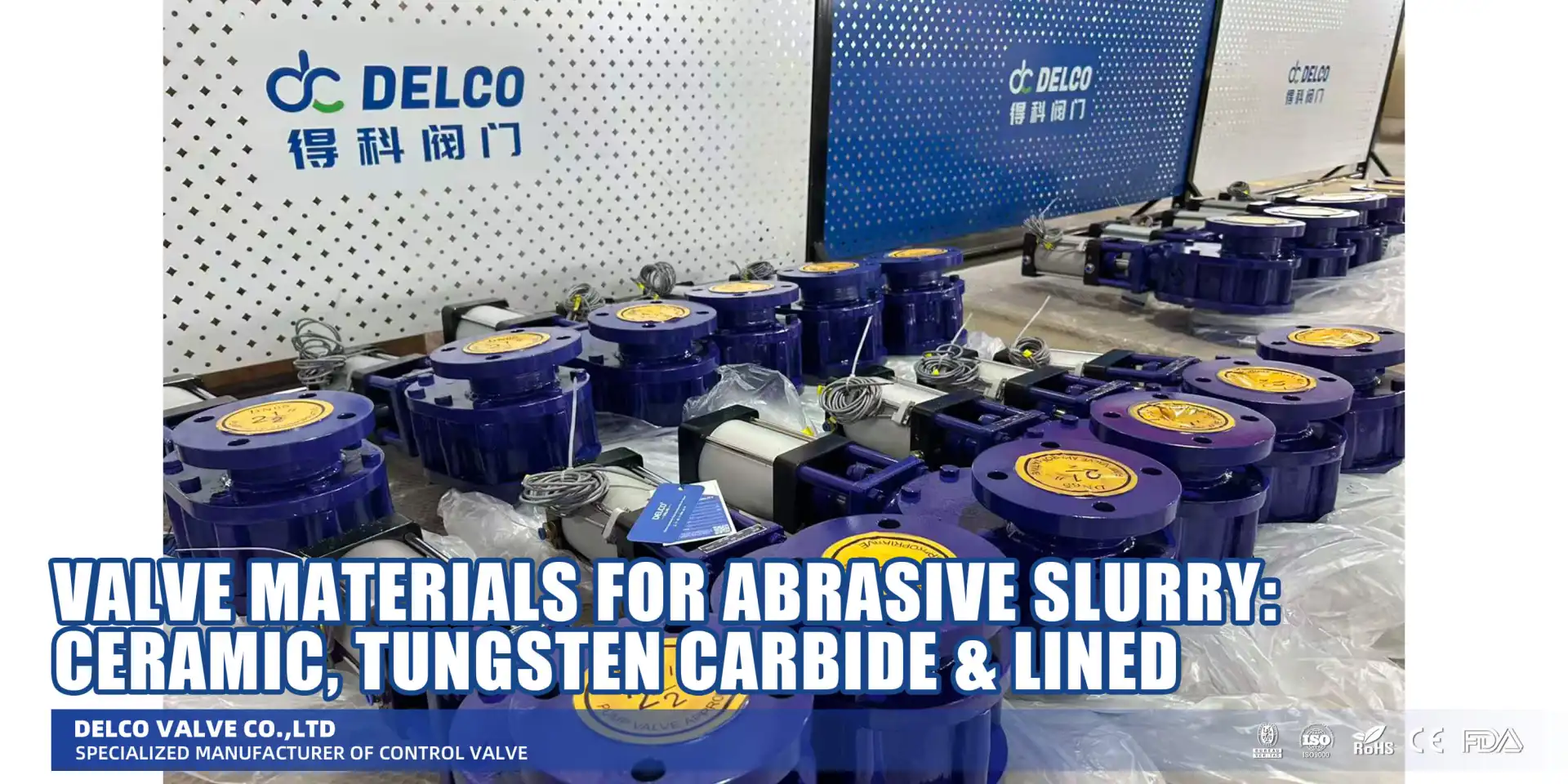
Valve Materials for Abrasive Slurry: Ceramic, Tungsten Carbide & Lined
Sep 22, 2026
Fail-Safe Electric Actuated Valves: What Happens on Power Loss
Sep 17, 2026
Introduction: The Challenge of Abrasive Slurries
Imagine a high-pressure mining tailings pipeline carrying a 40% solids mixture at 5 meters per second. Standard WCB carbon steel or CF8M stainless steel valves in this environment don't just wear out—they fail catastrophically, sometimes within weeks or even days. The aggressive combination of high-velocity particulate matter acting like liquid sandpaper can wash out a valve body wall or obliterate a seating surface, leading to severe environmental hazards, costly downtime, and significant safety risks.
For process engineers, pipeline designers, and plant operators, selecting an abrasive slurry valve is rarely about finding the cheapest option; it is about finding the only option that will survive. When dealing with mining tailings, ash handling, cement slurry, or mineral processing, standard valve materials simply cannot withstand the erosive forces at play.
Material selection is undeniably the number one factor in determining a valve's survival in abrasive services. The choice between a ceramic valve, a tungsten carbide valve, or a lined valve for slurry will dictate your system's reliability, maintenance intervals, and overall total cost of ownership (TCO). In this comprehensive guide, we will explore the tribology of slurry erosion, analyze the best slurry valve materials on the market, and provide a framework for selecting the right valve for your specific industrial application.
What Makes Slurry Abrasive? The Physics of Erosion
Before we can effectively select a protective material, we must first understand the enemy. Slurry erosion is a complex tribological process where solid particles entrained in a fluid repeatedly strike a solid surface, causing material removal. The severity of this erosion is dictated by several critical factors:
1. Particle Hardness (Mohs Scale)
The fundamental rule of abrasive wear is that the eroding particle must be harder than the surface it strikes to cause significant damage. Quartz (Mohs 7), commonly found in sand and mining tailings, will rapidly erode standard steel (Mohs 4-5). To counter this, the slurry valve material must have a hardness significantly higher than the entrained particles.
2. Particle Size and Shape
Larger particles carry more kinetic energy and cause greater impact damage. Furthermore, angular, sharp-edged particles (like freshly crushed ore) are significantly more erosive than smooth, rounded particles (like river sand). An angular particle acts as a microscopic cutting tool when it strikes the valve trim.
3. Concentration (% Solids by Weight or Volume)
Higher solid concentrations mean more impacts per second. However, the relationship isn't strictly linear. At very high concentrations, particles can interact with one another, sometimes dampening the impact velocity, but causing severe sliding abrasion (three-body wear) instead of direct impingement.
4. Velocity
Erosion rate is exponentially proportional to fluid velocity—typically modeled as E∝Vn, where 'n' usually ranges from 2 to 3 depending on the material and flow conditions. This means doubling the velocity of a slurry can increase the erosion rate by four to eight times. This is why throttling high-pressure slurries is notoriously difficult and requires specialized trim.
5. Angle of Impingement
The angle at which particles strike a surface determines the type of wear.
- Low-angle impingement (15°-30°): Causes sliding abrasion and cutting wear. Ductile materials (like steel) suffer greatly here.
- High-angle impingement (75°-90°): Causes impact and fatigue wear. Brittle materials (like some ceramics) can micro-fracture under this stress. Elastomers, such as rubber linings, are excellent at resisting high-angle impact because they deform and rebound, absorbing the kinetic energy.
Common Valve Failure Modes in Slurry Service
When inappropriate materials are chosen, abrasive slurries will exploit any weakness in a valve design. Understanding these failure modes is essential for implementing the correct preventative measures.
Erosion of Seat and Disc
The seating areas (where the disc/plug meets the seat ring) are high-velocity zones. When a valve is cracking open or near closing, the flow area is restricted, causing a massive spike in fluid velocity. This high-speed slurry acts like a waterjet cutter, washing out the seats and rendering the valve incapable of providing a tight shut-off. Once a small leak path develops, the high-velocity leak will rapidly expand the hole in a process known as "wire-drawing."
Washout of the Body Wall
Particularly in valves with tortuous flow paths (like standard globe valves) or sharp turns, the slurry impinges directly on the valve body wall. Over time, this localized erosion thins the pressure boundary, eventually leading to a rupture and catastrophic failure.
Packing and Seal Degradation
Fine abrasive particles can migrate into the stuffing box or trunnion bearings. Once inside, they act as a lapping compound, scoring the valve stem and destroying the packing material or dynamic seals, resulting in hazardous fugitive emissions.
Clogging, Scaling, and Jamming
In applications like alumina refining (Bayer process) or cement handling, slurries can settle, dewater, or scale up when the flow stops. This solid block can jam a standard gate or ball valve, breaking the stem if the actuator attempts to force it open.
Material Options for Abrasive Slurry Valves
To combat these severe conditions, engineers rely on a specific class of advanced materials. At DELCO Valves, we specialize in applying these materials to our industrial valve designs to ensure maximum longevity in your toughest applications.
a. Ceramic (Alumina Al₂O₃, Silicon Carbide SiC, Zirconia ZrO₂)
Ceramic valves represent the pinnacle of wear resistance. Structural ceramics possess extreme hardness (HRA 85-92), placing them near the top of the Mohs scale, second only to diamonds and a few synthetic materials.
- Alumina (Al₂O₃): The most common and cost-effective structural ceramic. Offers excellent abrasion and corrosion resistance.
- Silicon Carbide (SiC): Harder and more resistant to thermal shock than alumina.
- Zirconia (ZrO₂): Known as "ceramic steel," Zirconia has higher fracture toughness, making it less brittle and more resistant to mechanical impact.
Best for: Fine, highly abrasive particles (like coal dust, fly ash, or fine tailings), especially when combined with corrosive chemicals (e.g., acid leaching in mining). Ceramic ball valves provide unmatched performance in modulating these media. Limitations: Ceramics are inherently brittle. They cannot handle severe mechanical impact, water hammer, or extreme thermal shock (rapid temperature fluctuations).
b. Tungsten Carbide (WC)
A tungsten carbide valve utilizes one of the most robust engineering materials available. Tungsten Carbide is a metal matrix composite where extremely hard tungsten carbide particles are bound together by a ductile metal binder (usually Cobalt or Nickel).
- Hardness: HRA 89-92, providing exceptional abrasion resistance.
- Toughness: Unlike ceramics, the metallic binder gives WC significantly higher fracture toughness. It can withstand impacts that would shatter a solid ceramic part.
Best for: High-velocity slurries, severe erosion, and high-pressure throttling applications (like severe service globe control valves). Tungsten carbide is typically used as a solid component (for plugs/seats) or as a thick hardfacing overlay on stainless steel base materials. Limitations: High cost, heavy weight, and specific chemical limitations (some binders can be attacked by certain acids).
c. Rubber-Lined and Elastomer-Lined
Instead of trying to be harder than the abrasive particles, rubber linings take the opposite approach: absorption. Natural rubber, neoprene, EPDM, and polyurethane linings are highly resilient. When an abrasive particle strikes the rubber, the elastomer deforms, absorbs the kinetic energy, and then bounces back, deflecting the particle without losing material.
Best for: Coarse particles, high-volume mineral processing, and low-to-medium velocity applications. A lined valve for slurry (like a rubber-lined butterfly valve) is often the most economical choice for large-diameter pipelines handling thick, coarse tailings. The elastomer also provides excellent tight shut-off and is somewhat "self-cleaning." Limitations: Temperature restrictions (most rubbers degrade above 80-120°C). Not suitable for high-velocity throttling where the rubber can be torn or debonded by high shear forces.
d. PTFE / PFA Lined
Fluoropolymers like PTFE (Teflon) and PFA offer the ultimate chemical resistance combined with moderate abrasion resistance and a very low coefficient of friction.
Best for: Slurries that are intensely corrosive but only mildly abrasive (e.g., chemical process slurries, acid sludges, pharmaceutical suspensions). The non-stick nature prevents scaling and buildup. Limitations: Cannot handle severe, high-velocity abrasion or sharp, coarse particles which will gouge and cut the soft plastic lining.
e. Stellite and Chrome Carbide Overlay
For moderate slurry applications, applying a hardfacing overlay to standard metal (like a 316 Stainless Steel plug) is a highly cost-effective upgrade. Stellite (a cobalt-chromium alloy) or Chrome Carbide provides a hardened surface layer that significantly extends lifespan over bare steel.
Best for: Moderate abrasion, high temperatures, and applications where solid carbide or ceramic is cost-prohibitive. Frequently used in gate valves and ball valves dealing with light ash or dirty water.
Material Comparison Table: Choosing the Right Protection
To simplify your decision-making process, here is a comparative overview of the primary slurry valve materials:
| Material Type | Typical Hardness | Max Temp (°C) | Chemical Resistance | Impact/Mechanical Toughness | Relative Cost | Best Application Profile |
|---|---|---|---|---|---|---|
| Alumina Ceramic | HRA 85-88 | 1000+ | Excellent | Low (Brittle) | High | Fine, erosive & corrosive slurries; fly ash |
| Zirconia Ceramic | HRA 88-90 | 800 | Excellent | Medium | Very High | Abrasive slurries requiring moderate toughness |
| Tungsten Carbide | HRA 89-92 | 500-800 | Good (Binder dependent) | High | Very High | Severe high-velocity throttling; choke valves |
| Natural Rubber | Shore A 40-60 | 80 | Poor to Fair | Excellent | Low | Coarse mining tailings; low velocity isolation |
| Polyurethane | Shore A 60-90 | 80-100 | Fair | Excellent | Low to Medium | High wear, abrasive mineral slurries |
| PTFE / PFA | Shore D 50-60 | 200-260 | Outstanding | Low | Medium | Highly corrosive, mildly abrasive chemical slurries |
| Stellite 6 Overlay | HRC 38-45 | 800+ | Good | High | Medium | Moderate slurry; high temp dirty service |
Valve Types Best Suited for Slurry Service
Selecting the right material is only half the battle; combining it with the right valve geometry is crucial. Not all valve designs can handle solids.
- Pinch Valves: Often considered the ultimate slurry valve for heavy, coarse media. The flow path is completely unobstructed (full bore), and isolation is achieved by pinching a thick rubber sleeve shut. There are no cavities for slurry to pack into, and the rubber sleeve absorbs abrasion perfectly.
- Knife Gate Valves: Designed specifically to cut through thick slurries, paper pulp, and mine tailings. When equipped with a polyurethane or rubber seat and a hardened gate, knife gate valves provide reliable isolation in high-solid environments without jamming.
- Ceramic Ball Valves: For high-performance throttling and isolation of fine, highly erosive media (like coal dust injection or pneumatic conveying), ceramic ball valves are unmatched. The ball and seats are solid structural ceramic, ensuring zero leakage even after thousands of cycles.
- Rubber-Lined Butterfly Valves: For large-bore (DN200 to DN1200) low-pressure isolation in water treatment or mineral processing. They offer a cost-effective, compact solution. Check out our robust butterfly valve range.
- Globe Control Valves with WC/Ceramic Trim: When you need precise flow control of an abrasive slurry (e.g., letdown stations), a standard globe valve will wash out instantly. Specially engineered globe control valves featuring tungsten carbide plugs and seats, combined with expanded body galleries to reduce velocity, are required.
Selection Guide: Matching Material to Slurry Type
How do you choose? Use this application matrix to match your specific industry requirement with the optimal valve configuration.
| Industry & Application | Fluid Characteristics | Recommended Valve Type | Recommended Trim/Material |
|---|---|---|---|
| Mining: Tailings Pipelines | Coarse particles, high volume, abrasive | Pinch Valve or Knife Gate | Natural Rubber or Polyurethane lining |
| Mining: Autoclave Letdown | High pressure, fine particles, acidic (corrosive + erosive) | Severe Service Globe Valve | Solid Tungsten Carbide trim, Titanium body |
| Power Generation: Fly Ash | Dry, fine, highly abrasive, high temp | Ball Valve or Dome Valve | Solid Alumina or Zirconia Ceramic |
| Chemical Processing: Sludge | Corrosive chemicals, moderate solids | Plug Valve or Ball Valve | PFA Lined with Ceramic or PFA plug |
| Cement Plant: Slurry/Dust | Abrasive, prone to clogging/scaling | Pinch Valve or Ceramic Ball | Rubber sleeve or Solid Ceramic |
| Water Treatment: Sand/Grit | Light abrasion, low pressure, high volume | Butterfly Valve or Swing Check | EPDM/Rubber lined body, Stellite disc edge |
Note: For specialized check valve applications in slurry (preventing backflow of heavy sand/grit), specialized check valves with hardened trims or rubber linings are necessary to prevent the disc from jamming or wearing out.
Maintenance and Lifecycle Cost Considerations (E-E-A-T)
When dealing with a mining valve or an abrasive slurry valve, procurement managers often suffer from "sticker shock" when comparing a Tungsten Carbide valve to a standard Carbon Steel one. However, evaluating purely on Capital Expenditure (CAPEX) is a critical error. Operational Expenditure (OPEX) in slurry applications dwarfs initial costs.
The True Cost of a Cheap Valve
If a standard steel valve costs $1,000 but fails every 2 months, over a 5-year period, you will spend $30,000 in replacement valve costs alone. Factor in the labor to replace it (pipefitting, scaffolding, crane hire) and the cost of process downtime (which can exceed $50,000 per hour in a large mine), and that "cheap" valve is a multi-million dollar liability.
Conversely, a $10,000 ceramic valve or tungsten carbide valve that lasts for 4 to 5 years without maintenance pays for itself within the first few months of operation.
Maintenance Tips for Slurry Valves
Demonstrating true engineering expertise means knowing how to keep these valves running. Here are field-tested tips from DELCO engineers:
- Never use an isolation valve for throttling: Using a gate or standard ball valve partially open to control flow in a slurry line will destroy the seats rapidly due to the vena contracta effect. Use a dedicated control valve with hardened trim for throttling.
- Install in the correct orientation: For heavy slurries, installing valves with the stem horizontal can prevent solids from packing into the bottom cavity or stuffing box.
- Flushing ports are your friend: If your process allows, specify valves with body flushing ports. Purging the valve body with clean water or air before cycling can clear out settled solids and save the seats from grinding against abrasive chunks.
- Monitor actuation torque: As slurry valves wear or start to scale up, the required torque to open/close them will increase. Using electric actuated valves with intelligent diagnostic actuators can track this torque over time, giving you a predictive maintenance warning before a catastrophic jam occurs.
Frequently Asked Questions (FAQ)
Q1: What is the best valve material for highly abrasive mining tailings? For highly abrasive, coarse mining tailings at low to medium pressures, Natural Rubber or Polyurethane lined valves (like pinch or knife gate valves) are generally the best and most cost-effective choice. They absorb the impact of coarse rocks rather than fighting them.
Q2: When should I choose Tungsten Carbide over Ceramic for a slurry valve? Choose a tungsten carbide valve when the application involves high mechanical impact, extreme high velocities, or thermal shock, as Tungsten Carbide has higher fracture toughness. Choose a ceramic valve for fine, highly erosive particles and aggressive corrosive environments where temperatures are stable, as ceramics are highly corrosion-resistant but brittle.
Q3: Can PTFE/Teflon lined valves handle abrasive slurries? PTFE/PFA lined valves are excellent for corrosive chemicals but are relatively soft. They can handle mildly abrasive slurries with fine, soft particulates, but they will be quickly destroyed by coarse, sharp, or high-velocity abrasive slurries.
Q4: Why do my slurry valves keep jamming when closed? Jamming is usually caused by solids settling out of suspension and packing tightly into the valve cavities (like the bottom of a gate valve or the cavity behind a ball). Switching to a cavity-free design (like a pinch valve or a specialized filled-cavity ball valve) or utilizing flushing ports can solve this issue.
Q5: How does fluid velocity affect valve wear in abrasive service? Erosion rate increases exponentially with fluid velocity (often proportional to the cube of the velocity). Doubling the flow rate can increase the wear rate by 8 times. Reducing line velocity and minimizing pressure drops across the valve are critical steps in extending valve life.
Conclusion and Next Steps
Handling abrasive slurries is one of the most punishing applications in the industrial world. Standard valves are simply not up to the task. By understanding the tribology of your process and intelligently applying the right slurry valve material—whether that is a resilient rubber lining for coarse tailings, an impervious ceramic valve for fine ash, or a rugged tungsten carbide valve for high-pressure letdown—you can drastically reduce downtime, eliminate safety hazards, and optimize your total cost of ownership.
At DELCO Valves, we engineer solutions designed to survive where others fail. With extensive experience in supplying high-performance valves for mining, chemical, and mineral processing applications worldwide, our engineers are ready to help you solve your worst erosion problems.
Ready to upgrade your abrasive slurry systems?
- 📥 Download Our Complete Industrial Valve Catalog to see our full range of severe service solutions.
- 💬 Contact Our Valve Engineers for a custom material consultation and sizing recommendation for your specific pipeline.
- 🔍 Browse our range of Actuated Valves to find intelligent automation solutions for your heavy-duty applications.
Share on Social:


Contact Us
In This Article
Water Treatment Valve Selection Guide: Engineering Reliability and Compliance
Sep 28, 2026
Globe Control Valve: Working Principle, Types & Selection Guide
Sep 24, 2026
Valve Materials for Abrasive Slurry: Ceramic, Tungsten Carbide & Lined
Sep 22, 2026
Fail-Safe Electric Actuated Valves: What Happens on Power Loss
Sep 17, 2026